The DollarAngle
A realistic guide to joint, separate and hybrid bank accounts, financial transparency, independence and shared marriage goals.
She likes knowing exactly what is in her checking account. He thinks it is strange that married people still have “my money” and “your money.”
“Are we really a team if our accounts are separate?”
“Are we really a team if I have to ask before I buy lunch?”
The argument sounds like a debate about bank accounts. Usually, it is about security, freedom, trust and what marriage is supposed to mean.
There is no universal banking arrangement that makes a marriage healthy. There are three common systems, each with tradeoffs.

Option 1: Everything joint
Both partners put household income into shared accounts and pay spending, savings and bills from that pool.
Why couples like it: It can simplify bill payments and make shared goals visible. This may work particularly well when one partner pauses paid work for childcare or caregiving.
Where it can fail: Without agreed personal spending money, ordinary purchases can become permission requests. A financially controlling partner might restrict access or monitor every expense.
It is important to distinguish shared financial responsibility from one person controlling the other.
Option 2: Everything separate
Each partner keeps individual accounts and agrees who handles particular shared bills, or reimburses the other partner.
Why couples like it: Personal independence, clearer separation of some transactions and established habits.
Where it can fail: If one person earns substantially less, or performs more unpaid care, the arrangement may create unequal burdens. Separate accounts also do not erase marital property rights or obligations under state law.
Option 3: The hybrid system
Both partners keep personal accounts and contribute agreed amounts to a shared account for household expenses and goals.
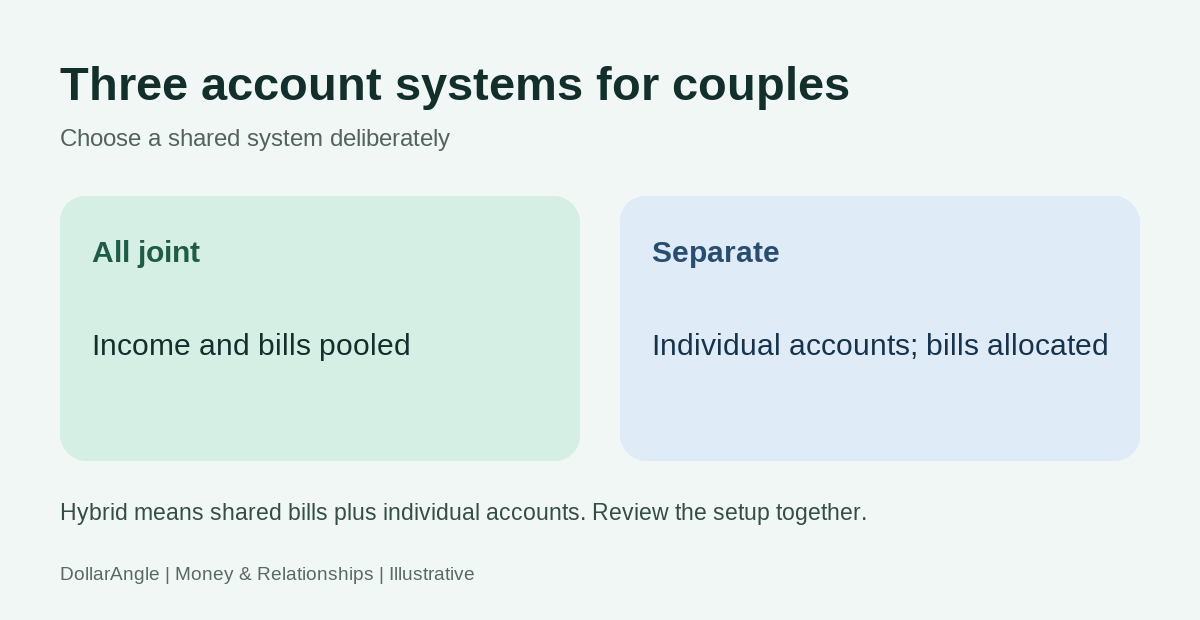
This is often the easiest starting point for couples with different spending styles. But it still requires clear rules for contributions, emergencies and long-term savings.
What should be shared even if bank accounts aren’t?
You do not need to reveal every coffee purchase. But decisions about a shared household require a shared understanding of:
- Reliable income and fixed bills
- Material debt, minimum payments and interest costs
- Emergency savings and insurance coverage
- Retirement contributions and investment risks
- Caregiving plans, family support and financial goals
The FDIC recommends conversations about accounts, budgets, credit and debt when couples combine their lives.
Equal contributions are not always equitable
Suppose a couple takes home $7,000 and $3,000 per month. If their shared bills total $4,000, a 50-50 approach leaves the lower earner with $1,000 and the higher earner with $5,000 before personal expenses and savings.
A proportional approach would put in $2,800 and $1,200, leaving different absolute amounts but a more comparable share of income.
Some marriages choose an entirely pooled approach because they see all income as a shared resource. The point is to discuss what fairness means in your household, including the value of unpaid work.
What if one person stays home with the children?
Unpaid caregiving is work that enables the family to function. A spouse who does it should not have to beg for basic money or be excluded from financial information.
Consider personal spending allocations, retirement planning, insurance and access to emergency funds for both partners. If responsibilities or earnings change, revisit the system rather than freezing rules from the start of the marriage.
What about ownership, safety and account protections?
The FDIC explains deposit insurance coverage for joint accounts and how account ownership can affect protection. Verify the specific ownership category, account titling and institution.
For a joint account, either owner may have significant access rights. The precise powers and obligations depend on account terms and applicable law. Don’t create joint accounts casually, especially in an unsafe or financially coercive relationship.
The conversation that beats arguing about whose paycheck it is
“I want us to save for a home, but I also want money I can spend without explaining every little thing.”
“I want to know we’re both contributing to retirement and the emergency fund.”
“Then let’s automate those goals first and agree on personal spending money for each of us.”
That is the healthy compromise: shared priorities, clearly defined responsibilities and dignity for both people.
A practical system to try for 90 days
Pick joint, separate or hybrid. Automate essential bills and shared savings. Agree on an amount above which you will consult each other before spending from joint funds. Give each partner reasonable personal financial autonomy. Hold a 20-minute monthly review and change the setup if it isn’t working.
The best account arrangement is the one you can both understand, access and sustain without resentment or secrecy.
For the relationship foundations behind the numbers, see seven money conversations every couple should have.
Educational information, not personalized financial or legal advice. Marriage and property laws vary by jurisdiction.