The DollarAngle
An ETF is a container, not a strategy. What matters is what the fund owns, what it costs and how it fits into your portfolio.
An exchange-traded fund, or ETF, is an investment fund whose shares trade on an exchange.
One ETF can hold dozens, hundreds or even thousands of securities.
That makes ETFs useful, but the three letters alone do not tell you whether an investment is diversified, cheap, conservative or appropriate for your goals.
The easiest way to understand an ETF is to think of it as a container.
The important question is what is inside.
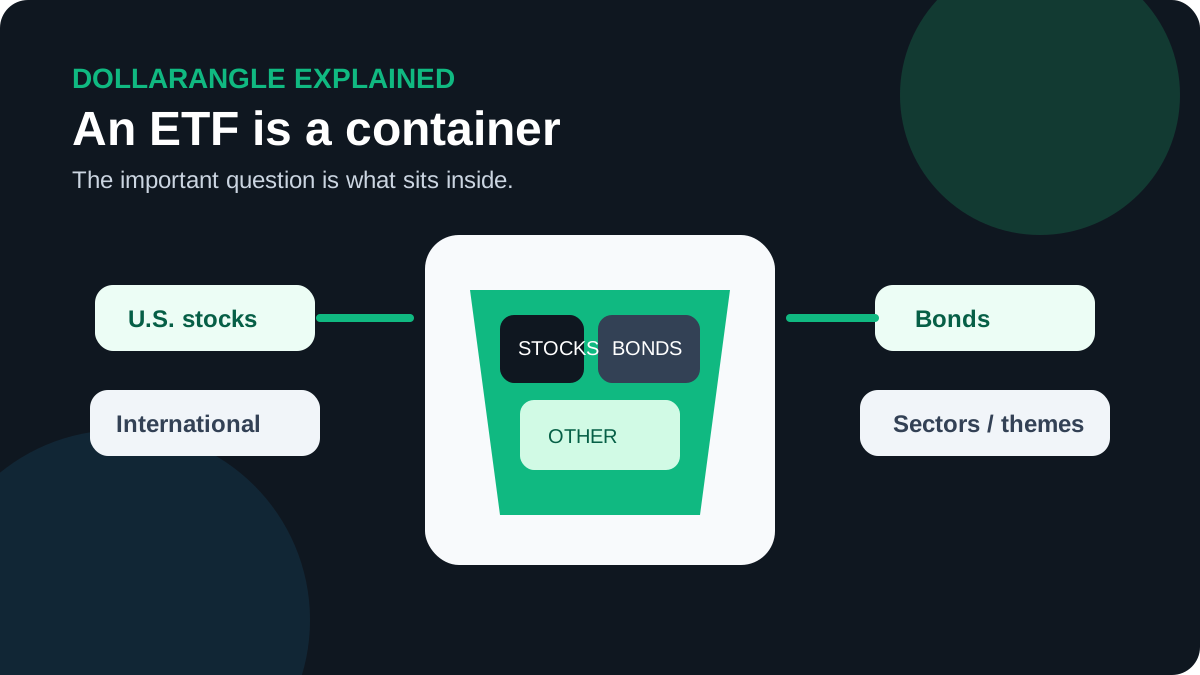
ETFs can package many different assets into one tradable fund. The wrapper matters less than the holdings inside it.
What can an ETF hold?
Depending on its mandate, an ETF can hold:
- U.S. stocks,
- international stocks,
- government or corporate bonds,
- real-estate securities,
- commodities or commodity-linked instruments,
- narrow industries or investment themes,
- other funds,
- or more complex exposures using derivatives.
A broad-market stock ETF and a leveraged single-sector ETF can share the same basic wrapper while carrying completely different risks.
That is why the word “ETF” should never be treated as a risk rating.
Why investors use ETFs
The main appeal is convenience.
Instead of buying hundreds of companies individually, an investor can buy one fund designed to track a broad index or follow a defined strategy.
That can make diversification easier and reduce the amount of portfolio maintenance required.
Investor.gov notes that ETFs and mutual funds can both help investors spread money across many investments, although some funds are much less diversified than others.
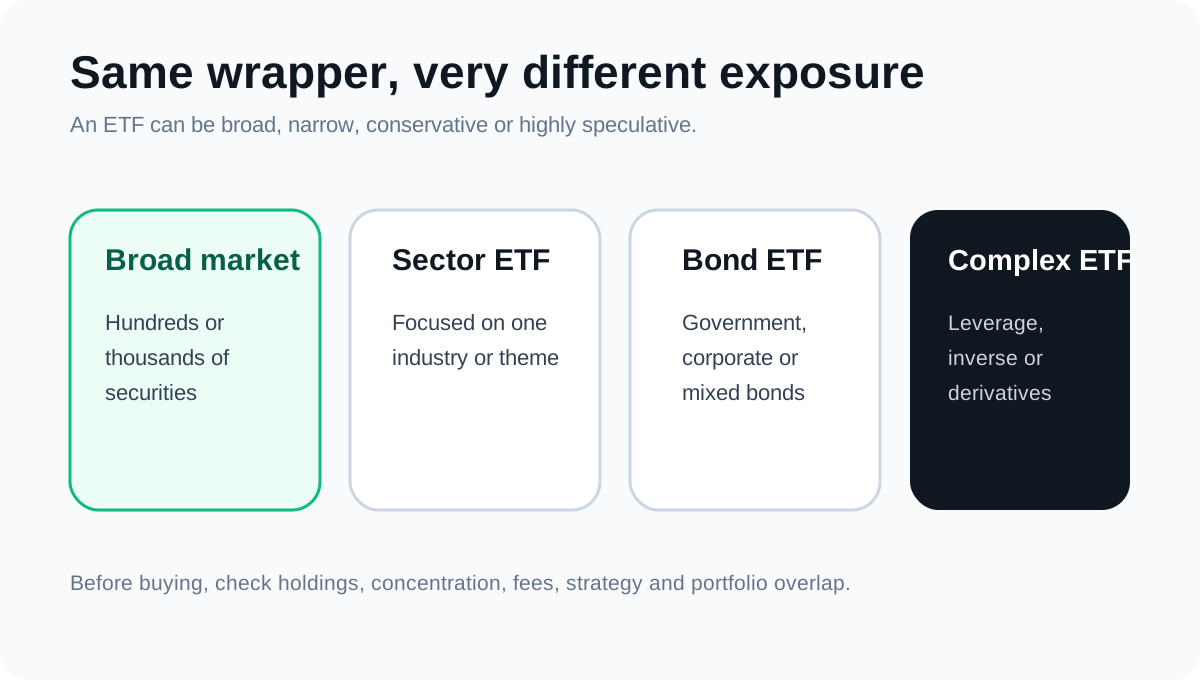
The same ETF structure can hold very different things. Always look through the wrapper.
ETF does not automatically mean index fund
Many popular ETFs track indexes, but not every ETF is passive.
Some are actively managed.
Some follow rules-based strategies.
Others focus on themes such as artificial intelligence, clean energy, cybersecurity, dividends, low volatility or a specific commodity.
So when comparing funds, ask:
- What exactly does the fund own?
- What benchmark or strategy does it follow?
- How concentrated are the largest holdings?
- What is the expense ratio?
- How liquid is the fund?
- Does it overlap heavily with funds I already own?
The ticker symbol is only the starting point.
Diversification is not automatic
A fund can own fifty securities and still be highly concentrated if most of those holdings belong to the same sector or respond to the same economic risks.
Likewise, owning several ETFs does not guarantee diversification if their largest holdings overlap.
A technology ETF, a growth ETF and a large-cap index ETF might all own many of the same companies.
That can create more concentration than the number of fund names suggests.
The SEC’s Investor.gov materials also note that some ETFs may track a single stock or otherwise provide far less diversification than investors expect.
Look at the holdings, not just the label.
Costs matter more than they look
ETF investors can face several types of cost:
- expense ratio: the fund’s annual operating expenses,
- bid-ask spread: the difference between the price buyers offer and sellers ask,
- brokerage or platform costs: depending on the provider,
- premium or discount to NAV: the market price can trade above or below the value of the underlying holdings,
- tax costs: depending on the account and transactions.
Investor.gov emphasizes that fund fees reduce investment returns and that even small differences can matter over long periods.
That does not mean the cheapest ETF is always the best.
It means a higher cost should be justified by something you actually value.
ETFs trade during the day
ETF shares trade on exchanges while markets are open.
Traditional mutual funds generally transact at an end-of-day net asset value.
Intraday trading can be useful.
It can also tempt a long-term investor to turn a simple investment into a constant trading exercise.
A product that makes diversified investing easy does not require you to watch the price every fifteen minutes.
More trading is not automatically more sophisticated.
ETFs can still lose a lot of money
A diversified wrapper does not eliminate market risk.
If the assets inside the fund fall, the ETF can fall.
Bond ETFs can face interest-rate and credit risk.
International funds can face currency, political and market risks.
Narrow thematic funds can be especially volatile.
Some ETFs use leverage, derivatives or inverse strategies. Those products can behave very differently from a conventional broad-market fund and may be designed around short-term objectives rather than long-term holding.
Read the prospectus and understand the strategy before assuming that two ETFs are comparable.
ETF versus individual stocks
An individual stock gives you direct exposure to one business.
That can create significant upside if the company performs exceptionally well, but it also creates much greater company-specific risk.
A diversified ETF can spread that risk across many holdings.
That is why many long-term investors use diversified funds as a core and reserve individual stock picking, if they do it at all, for a smaller part of the portfolio.
The tradeoff is straightforward:
- individual stock: more company-specific upside and downside,
- diversified fund: less dependence on one company being right.
ETF versus mutual fund
Both can provide diversified fund exposure.
Important differences can include:
- how shares trade,
- account availability,
- minimum investments,
- bid-ask spreads,
- tax treatment in taxable accounts,
- fees,
- and whether the fund is active or index-based.
Investor.gov notes that ETFs trade on exchanges throughout the day, while mutual fund transactions generally occur at the next calculated NAV.
Do not choose based only on the product label.
Compare the actual funds available in your account.
A practical ETF checklist
Before buying an ETF, look for:
1. Objective
What is the fund actually trying to do?
2. Holdings
What do you own after buying one share?
3. Concentration
How much of the fund sits in its largest holdings or one sector?
4. Cost
What are the expense ratio and likely trading costs?
5. Overlap
Does another fund in your portfolio already own most of the same assets?
6. Role
Why does this fund belong in your portfolio at all?
If you cannot answer the last question, the ticker probably does not belong there yet.
The DollarAngle
An ETF can be a powerful tool because it can make diversification simpler.
But the wrapper is never the investment thesis.
Before buying, look through the ticker and ask what you are actually owning, how concentrated it is, what it costs and what role it plays in the rest of your portfolio.
Simple can be good.
Blind is not.
Sources and further reading
- Investor.gov: Exchange-Traded Funds
- Investor.gov: Updated Investor Bulletin on Exchange-Traded Funds
- Investor.gov: Mutual Fund and ETF Fees and Expenses
- Investor.gov: Characteristics of Mutual Funds and ETFs
DollarAngle provides financial education and commentary for informational purposes only. Investing involves risk, including possible loss of principal.