The DollarAngle
Your next dollar should usually go where it removes the biggest financial fragility or captures the clearest benefit, not wherever social media is most excited today.
When money is tight, almost every financial goal can sound urgent at the same time.
Build an emergency fund. Pay off debt. Contribute to a 401(k). Open an IRA. Invest in stocks. Save for a house. Buy insurance. Build credit.
Trying to do all of them aggressively at once can leave you making tiny progress everywhere and meaningful progress nowhere.
A better approach is to use an order of operations: a sequence that protects you from common financial shocks first, captures unusually valuable benefits next, and then moves toward longer-term wealth building.
This is a framework, not a personalized financial plan. Your taxes, job stability, family situation, insurance needs and debt terms can change the order.

A clear financial system starts by giving each dollar a job.
The quick order
- Keep essential bills and minimum debt payments current.
- Build a starter emergency buffer.
- Capture an employer retirement match when available and appropriate.
- Pay down expensive consumer debt.
- Expand your emergency reserve.
- Increase retirement and long-term investing.
- Fund medium-term goals separately.
- Raise your investing rate as income grows.
The details matter, but this sequence gives each new dollar a clear job.
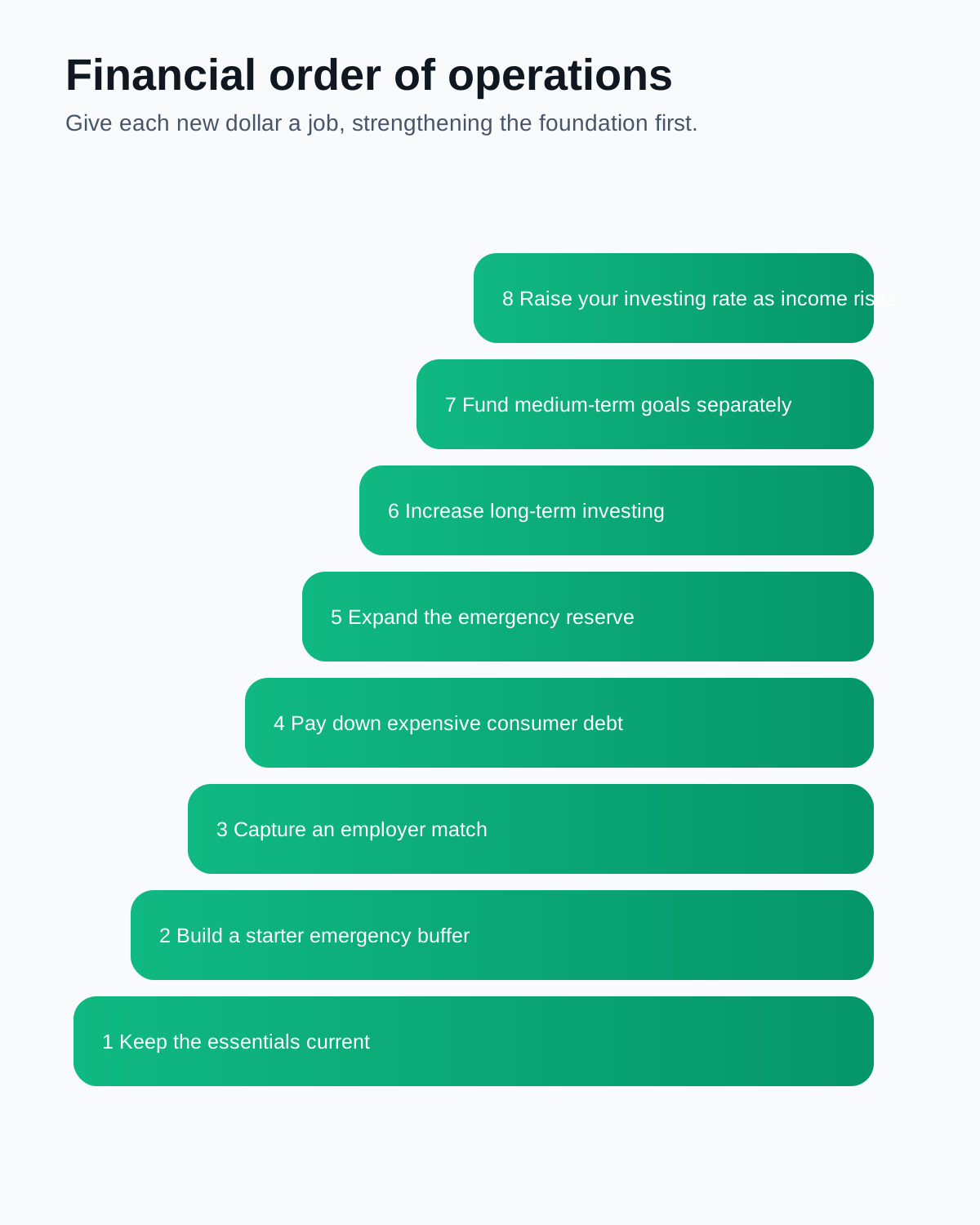
Visual summary: the order starts with stability, then moves to benefits, debt reduction, resilience and long-term ownership.
Step 1: Keep the financial machine running
Before optimizing investments, make sure your basic obligations can be paid.
Housing, utilities, food, transportation, insurance premiums and minimum required debt payments belong here.
This sounds obvious, but it matters because a strategy that maximizes long-term return while causing missed rent or loan payments is not financially strong.
Liquidity has value.
If cash flow is routinely negative, start with the gap.
Track where money is going, identify expenses that can actually change, and look for income improvements with enough impact to matter.
The first objective is not maximizing returns.
It is creating enough stability that your financial plan can survive normal life.
Step 2: Build a first-line emergency buffer
You do not need to jump instantly from zero savings to six months of expenses.
A practical first milestone is enough cash to absorb the type of surprise that would otherwise go straight onto a credit card:
- a car repair,
- medical bill,
- insurance deductible,
- urgent trip,
- home repair,
- or another unexpected expense.
The Consumer Financial Protection Bureau describes an emergency fund as a cash reserve for unplanned expenses or financial emergencies and notes that even small savings can improve financial resilience.
The point of this first buffer is not investment return.
It is stopping normal life from becoming expensive debt.
That distinction matters.
A savings account earning a modest return can still be extremely valuable if it prevents a $1,000 emergency from becoming a revolving credit-card balance.
Step 3: Capture an employer retirement match if you have one
If your workplace retirement plan offers matching contributions, understand the formula and the vesting rules.
An employer match is unusual because it can create an immediate additional contribution tied to your own saving.
The IRS encourages workers to understand their plan’s matching formula and contribute enough to benefit from matching contributions when feasible.
For example, your employer might match:
- 100% of your contributions up to 3% of salary,
- 50% of contributions up to 6%,
- or another formula entirely.
Do not assume every employer match works the same way.
Your own salary deferrals are vested immediately. Some employer contributions can vest over time depending on the terms of the plan.
That means you should understand both the matching formula and the vesting schedule.
Leaving an employer soon after receiving matching contributions can sometimes affect how much of the employer-funded portion you ultimately keep.
Step 4: Attack expensive consumer debt
High-interest debt can work against wealth building with remarkable efficiency.
If a credit card balance is charging a high annual percentage rate, paying it down can produce a very different risk-reward tradeoff from chasing uncertain investment returns while the debt compounds against you.
Suppose someone has credit-card debt costing 22% per year.
Paying that balance down avoids a known high financing cost.
By comparison, future stock-market returns are uncertain.
Stocks may produce attractive long-term returns, but those returns do not arrive smoothly or on demand.
That is why comparing expensive debt directly with expected investment returns can be misleading.
One is a known cost.
The other is an uncertain outcome.
Two common debt repayment strategies are:
Avalanche method: direct extra money toward the highest interest-rate debt first.
Snowball method: direct extra money toward the smallest balance first to create faster psychological wins.
Mathematically, the avalanche usually minimizes total interest when everything else is equal.
Behaviorally, the snowball can work better for someone who needs visible progress to remain consistent.
The best system is the one you can actually follow without missing minimum payments.
Step 5: Expand your emergency reserve
Once the most fragile parts of your finances are stabilized, build a more durable cash reserve.
There is no universal magic number.
Someone with variable self-employment income, one household income and high insurance deductibles may reasonably want more liquid reserves than someone with two stable incomes and strong employee benefits.
Instead of blindly copying a rule, think about the risks your household actually faces.
Consider:
- job stability,
- number of income earners,
- insurance deductibles,
- health expenses,
- dependents,
- housing costs,
- vehicle reliability,
- and how quickly you could replace lost income.
Think in terms of months of essential expenses, but tailor the target to your actual risk.
Emergency money should generally remain accessible and relatively low risk.
Its primary purpose is not maximum growth.
It is to reduce the probability that you will need to borrow money or sell investments during a bad moment.
Step 6: Build retirement and long-term investing contributions
After high-cost debt and short-term financial fragility are under better control, long-term investing becomes more powerful.
Why?
Because you are less likely to interrupt the strategy.
For U.S. workers, tax-advantaged retirement accounts can include workplace plans such as 401(k)s and individual retirement accounts.
The right choice between traditional and Roth treatment depends on factors such as taxes, eligibility and your broader financial circumstances.
At this stage, simplicity can have significant advantages.
Diversified funds can spread exposure across many securities without requiring you to correctly identify individual winners.
Investment fees also matter because every dollar paid in unnecessary costs is a dollar that is no longer available to compound.
The goal is not to build the most complicated portfolio.
The goal is to build a portfolio you understand, can afford and can continue holding through difficult markets.
Step 7: Fund medium-term goals separately
Money for a home down payment in two years should not automatically be invested like money intended for retirement in thirty years.
Time horizon matters.
Investor.gov explains that investors with longer time horizons may be able to tolerate more volatility, while shorter-term goals may require less volatile assets.
That means different goals can justify different places for your money.
Create separate buckets for goals such as:
- a house down payment,
- vehicle replacement,
- education,
- starting a business,
- major travel,
- planned home repairs.
This also creates psychological clarity.
Retirement savings stop looking like a general-purpose savings account.
Your emergency fund stays reserved for genuine emergencies.
And known future expenses get their own funding plan.
Step 8: Increase ownership as income rises
One of the quietest threats to wealth building is lifestyle inflation.
Income rises.
Spending rises.
Years later, the person earns substantially more but owns surprisingly little more.
A useful solution is to decide what happens to raises before the additional income becomes normal.
For example, part of every raise could go toward:
- better living today,
- increased retirement contributions,
- taxable investing,
- debt reduction,
- or another defined financial goal.
You do not need a perfect percentage.
The important thing is establishing the rule before lifestyle spending absorbs everything automatically.
As your income grows, your ownership rate should ideally grow with it.
What about investing while paying debt?
This is where rigid internet rules start to break down.
A low fixed-rate mortgage is not the same financial problem as revolving credit-card debt.
A 4% mortgage and a 25% credit-card balance should not automatically receive identical treatment.
An employer match changes the calculation.
Your emergency savings matter.
Taxes matter.
Job security matters.
Your investment time horizon matters.
Your ability to tolerate market declines matters.
Instead of asking only:
“Should I pay debt or invest?”
Ask these questions:
- What is the debt’s effective cost?
- How risky is the debt to my household?
- Is there an employer match I would lose by stopping contributions?
- Do I have enough liquid savings to avoid borrowing again after the next surprise?
- What is the time horizon for the money I would invest?
- Am I comparing a guaranteed financing cost with an uncertain investment return honestly?
This usually produces a better answer than a universal rule.
The DollarAngle
Personal finance becomes easier when every dollar has a job and those jobs have an order.
Do not optimize the roof while the foundation is cracked.
First create stability.
Then capture high-value benefits.
Then remove expensive liabilities.
Then build resilience.
Then scale ownership and long-term investing.
The goal is not a perfect financial sequence.
It is a financial system strong enough that one bad month does not destroy five years of progress.
Sources and further reading
- Consumer Financial Protection Bureau: An essential guide to building an emergency fund
- Consumer Financial Protection Bureau: Debt action plan
- Internal Revenue Service: Matching contributions help you save more for retirement
- Internal Revenue Service: Retirement topics, contributions
- U.S. Department of Labor: 401(k) plans for small businesses
- Investor.gov: Asset allocation and diversification
- Investor.gov: Understanding investment fees
DollarAngle provides financial education and commentary for informational purposes only. It is not personalized financial, investment, tax or legal advice. Investing involves risk, including possible loss of principal.