The DollarAngle
The first portfolio question is not which stock will win. It is what happens to your financial plan if your favorite idea is wrong.
Stock picking asks an exciting question:
What will outperform?
Portfolio construction asks a more useful question:
What happens if I am wrong?
That is the logic behind diversification.
Diversification cannot prevent market losses, and it cannot guarantee a profit. Its job is simpler. It reduces the chance that one company, one sector or one investment theme determines the outcome of your entire financial plan.
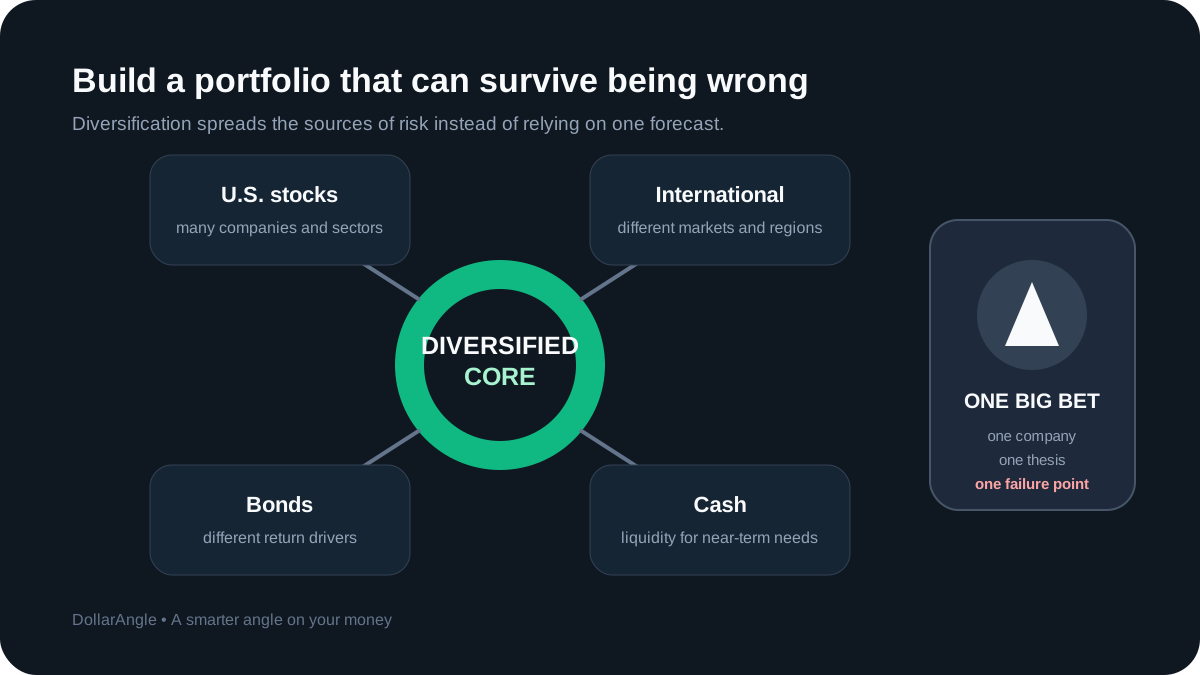
A durable portfolio does not need every investment idea to work. It needs individual mistakes to remain survivable.
The SEC’s Investor.gov describes diversification as spreading money among different investments to reduce risk. It also emphasizes that diversification can happen both across asset classes and within them.
That distinction matters.
Owning more investments is not automatically the same as being well diversified.
Concentration can magnify both success and failure
A concentrated position can create extraordinary gains if the thesis is right.
It can also create extraordinary damage if the thesis is wrong.
An individual company can be hurt by:
- product failures,
- management mistakes,
- fraud,
- lawsuits,
- technological disruption,
- changing customer behavior,
- financing problems,
- competition,
- regulation,
- or a permanent loss of relevance.
A broad portfolio still faces market risk. Stocks can fall together during recessions, financial stress or valuation resets. Diversification does not make a portfolio safe from every decline.
What it can do is reduce company-specific risk and concentration risk.
If one holding collapses, the question becomes whether it is an unpleasant setback or a financial catastrophe.
That is why position size matters as much as conviction.
Diversification happens at more than one level
A portfolio can look diversified on the surface while still depending heavily on the same underlying risk.
For example, owning ten technology stocks is broader than owning one technology stock. But all ten companies may still react to similar economic forces.
Owning several funds can create the same problem if their largest holdings overlap.
Investor.gov explains diversification at two broad levels:
- Between asset classes, such as stocks, bonds and cash.
- Within asset classes, such as different companies, sectors, industries or market segments.
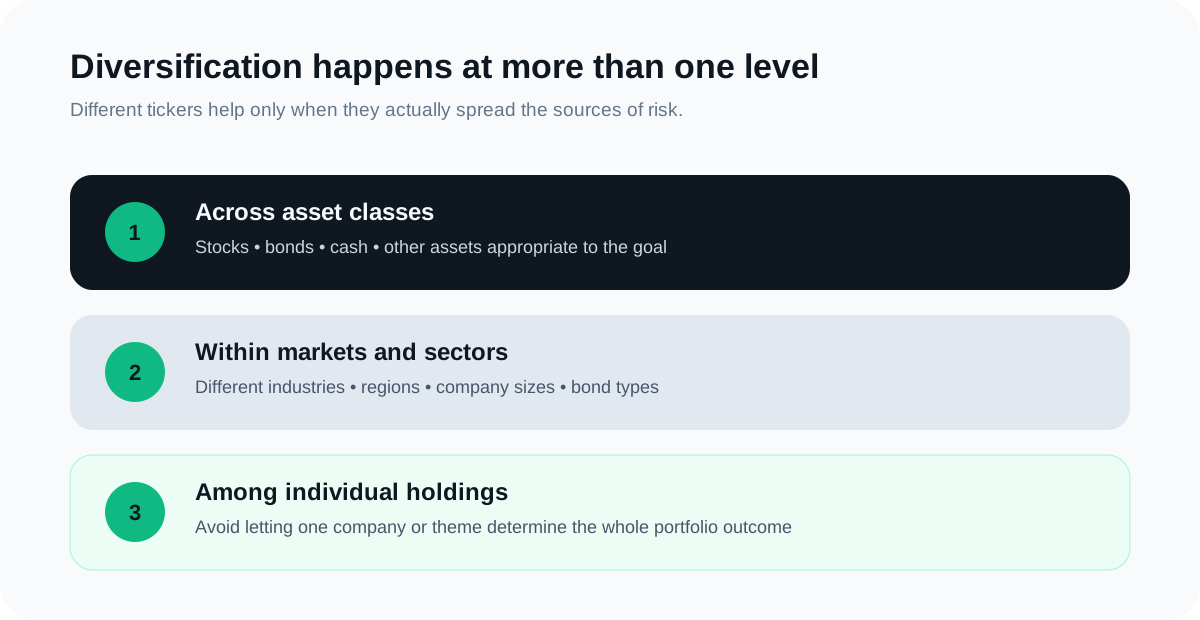
Diversification is layered. Different tickers are useful only when they actually spread the sources of risk.
The right mix depends on the job of the money.
Retirement money needed in thirty years has a different time horizon from a home down payment needed in two years. A portfolio should reflect that difference before it reflects an opinion about any particular stock.
An ETF is not automatically diversified
ETFs can make diversification easier because one fund can own many securities.
But the ETF label tells you the legal wrapper, not the level of diversification.
A broad-market ETF may hold hundreds or thousands of companies across many industries.
A narrow thematic ETF may hold a small group of businesses that depend on the same trend.
A sector ETF can own dozens of companies and still be highly concentrated in one part of the economy.
Investor.gov specifically warns that mutual funds and ETFs are not necessarily diversified when they are narrowly focused.
So look through the wrapper.
Ask:
- What index or strategy does the fund follow?
- How many holdings are there?
- How much of the fund sits in the top ten positions?
- Which sectors dominate?
- Which countries dominate?
- Do several funds in the portfolio own many of the same companies?
Five ETFs can still produce one concentrated portfolio.
Asset allocation comes before ticker selection
Asset allocation is the division of a portfolio among categories such as stocks, bonds and cash.
The SEC says the appropriate allocation depends on factors including time horizon and risk tolerance.
There is also a practical concept worth adding: risk capacity.
Risk tolerance describes how much volatility you are emotionally willing to accept.
Risk capacity describes how much loss your financial situation can actually absorb without forcing you to abandon the plan.
Those are not always the same.
Someone might feel comfortable with an aggressive portfolio but still need the money for a near-term goal. In that situation, the calendar matters more than confidence.
Before choosing individual stocks, ask:
- What is this money for?
- When might I need it?
- How large a temporary decline could I tolerate financially?
- How large a decline could I tolerate emotionally without panic selling?
- What portion of the portfolio needs stability rather than maximum growth?
Ticker selection comes after those questions.
Think in terms of a risk budget
A useful way to think about portfolio construction is to give concentration a risk budget.
Suppose you have a diversified long-term core and also want to own a few individual companies because you enjoy researching businesses.
The question is not whether stock picking is allowed.
The question is how large those positions can become before a mistake threatens the main financial goal.
One simple framework is core and satellite:
- Core: diversified investments designed to carry the long-term plan.
- Satellite: smaller positions where you take more specific company, sector or thematic risk.
There is no universal percentage that works for everyone.
The important idea is structural: the speculative or concentrated part should be small enough that a bad outcome does not destroy the core plan.
This also reduces the pressure to be right.
A stock idea is easier to evaluate rationally when your retirement does not depend on it.
Rebalancing is risk maintenance
Diversification is not a one-time purchase.
Markets move.
Suppose your original plan was 70% stocks and 30% bonds. After a long stock rally, stocks might grow to 80% or 85% of the portfolio even if you never changed your plan.
You now have a different risk profile simply because one part of the portfolio grew faster.
Rebalancing means moving the portfolio back toward its intended allocation.
Investor.gov describes several ways to do this:
- sell some of the overweight asset and buy the underweight asset,
- direct new money toward the underweight asset,
- or change ongoing contributions until the allocation moves back toward the target.
In taxable accounts, selling can create tax consequences. Transaction costs and account rules can matter too.
The point is not to rebalance constantly.
The point is to notice when the portfolio has drifted into a level of risk you did not intentionally choose.
Diversification often feels worst when you need it most
When one stock, sector or asset class is soaring, diversification can feel disappointing.
You will almost always own something that is not the current winner.
That is part of the tradeoff.
A portfolio optimized for the hottest investment of the last year would need perfect hindsight. A portfolio built for uncertainty assumes you do not have it.
Diversification is not designed to maximize bragging rights in a bull market.
It is designed to reduce the damage from being very wrong about one thing.
This can be psychologically difficult during bubbles and concentrated rallies because the diversified investor watches someone else make more money for a while.
The temptation is to abandon the plan and chase what already went up.
That is exactly when a written asset-allocation framework becomes useful.
A quick diversification test
Before adding another stock or fund, run five checks.
1. What already owns this risk?
Look at the holdings you have now.
If your broad-market fund already has a large position in the company you want to buy, adding the individual stock increases concentration rather than adding a new source of diversification.
2. What happens if this investment falls 50%?
Do not start with the probability.
Start with the consequence.
Would the loss delay retirement, a home purchase or another major goal?
If yes, the position may be too large even if the thesis seems attractive.
3. Are several holdings driven by the same story?
Different tickers can share the same economic exposure.
A collection of semiconductor stocks, AI infrastructure companies and technology funds might all depend heavily on similar assumptions about growth and capital spending.
4. Does the portfolio match the time horizon?
Money with a short deadline should not rely on a long recovery period.
A diversified stock portfolio can still fall sharply. Diversification within equities does not turn equities into cash.
5. Can you explain the role of every holding?
A portfolio becomes difficult to manage when investments accumulate without a clear purpose.
Each holding should have a job.
If you cannot explain what an investment adds that your existing portfolio lacks, it may be adding complexity rather than diversification.
The DollarAngle
You do not need a portfolio that wins every year.
You need one that can survive mistakes, bad timing and investments that do not work out.
Build the diversified core first.
Decide your asset allocation based on goals, time horizon and the amount of risk you can actually carry.
Then, if you want to pick individual stocks or make concentrated bets, size them so the main financial plan does not depend on being right.
That is a less exciting question than asking which stock will double next.
It is also a more durable way to build wealth.
Sources & further reading
- Investor.gov: Asset allocation and diversification
- Investor.gov: Beginner’s guide to asset allocation, diversification and rebalancing
- Investor.gov: Tips for 2026
- Investor.gov: World Investor Week 2026
DollarAngle provides financial education and commentary for informational purposes only. Investing involves risk, including possible loss of principal.