The DollarAngle
Compounding multiplies what you consistently contribute. It is not a substitute for saving enough, controlling fees and staying invested through imperfect markets.
Compounding is often described as if it were magic.
It is not magic. It is arithmetic plus time.
When an investment earns a return and that return stays invested, future gains can be earned on both the original money and the gains that have already accumulated.
Over long periods, that second layer can become increasingly important.
Investor.gov’s compound interest calculator is built around a few basic inputs: the amount you start with, how much you add, how long the money remains invested, the estimated rate of return, and how often returns are compounded.
Those inputs reveal the real lesson:
Compounding needs something to compound.
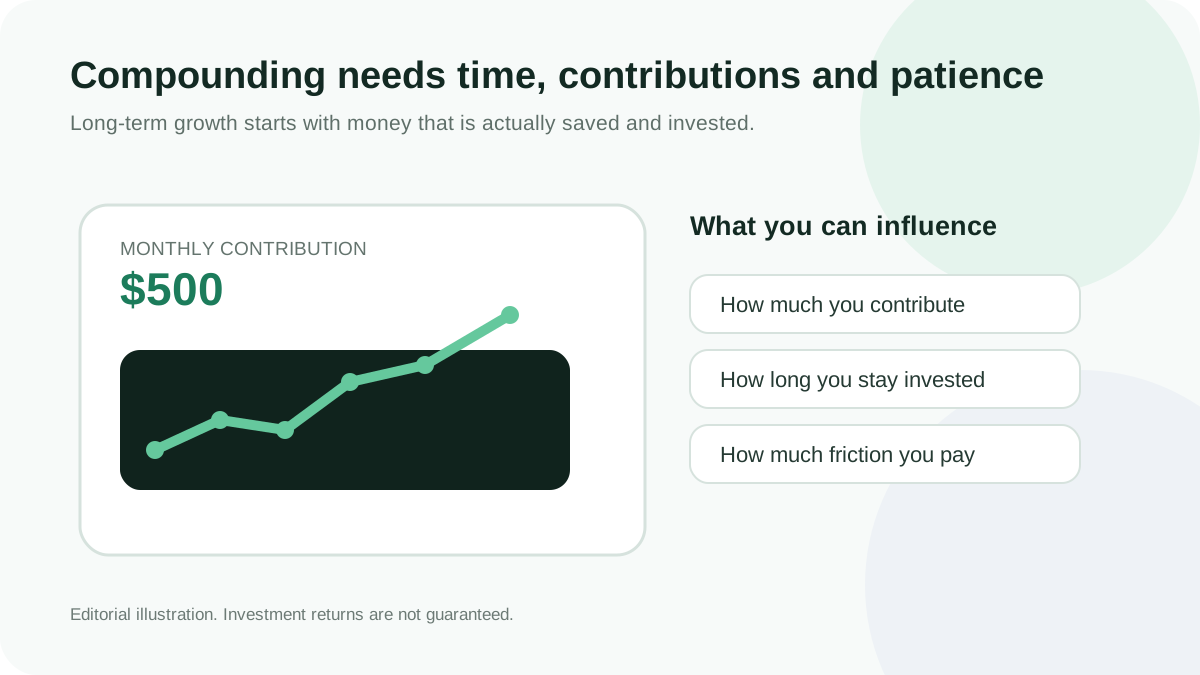
Compounding can amplify a disciplined savings habit, but it cannot replace the habit itself.
Time matters because it cannot be added retroactively
A person who starts contributing earlier gives each dollar more years to potentially grow.
Starting later does not make long-term wealth building impossible. It simply means fewer years remain, so larger contributions may be required to pursue the same target.
That is why early consistency can matter more than early sophistication.
A simple hypothetical example shows the effect.
If someone invested $200 per month and earned a constant 7% annual return, compounded monthly, the account would grow to roughly:
- $34,600 after 10 years,
- $104,200 after 20 years,
- $244,000 after 30 years,
- $525,000 after 40 years.
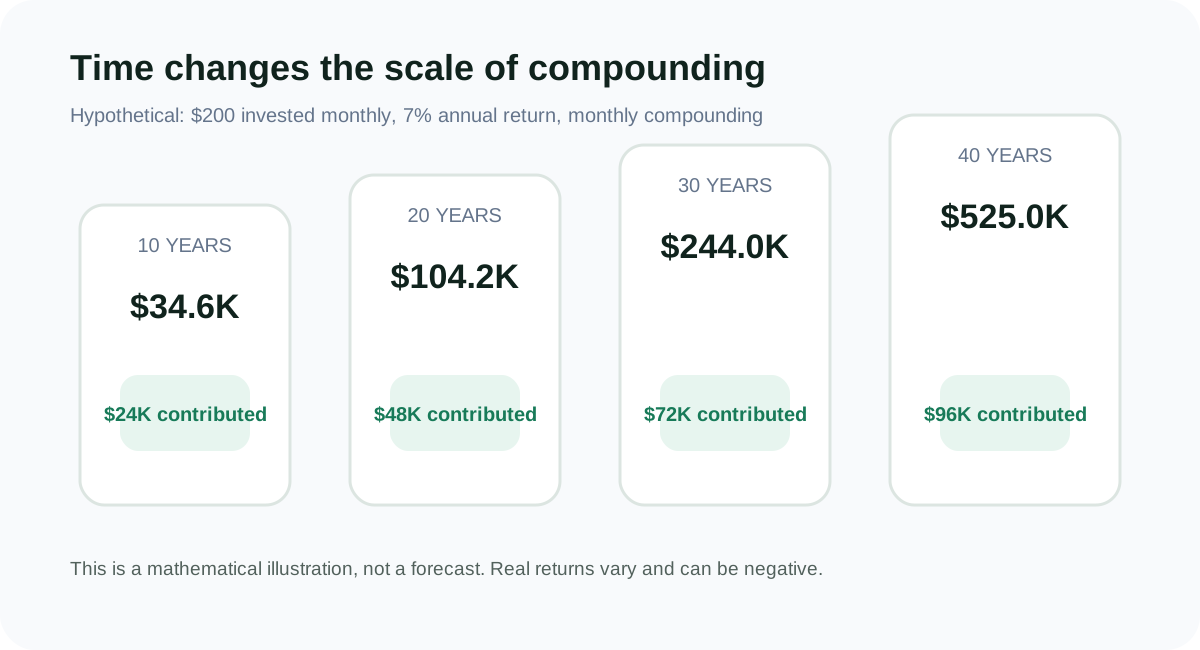
This is a mathematical illustration, not a forecast. Real investment returns vary, and actual results can be higher, lower, or negative.
The striking part is that the investor contributes $96,000 over 40 years, while the hypothetical ending value is much larger because earlier contributions had more time to compound.
That does not mean investors should assume a 7% return. It means time changes the scale of the math.
Your savings rate still matters
Finance content sometimes tells an unrealistic story:
Invest a tiny amount, wait long enough, and become rich.
That message leaves out an important variable.
Compounding can magnify disciplined saving, but it cannot guarantee a comfortable retirement from contributions that were never large enough in the first place.
If your long-term plan is off track, you usually have several levers:
- save more,
- earn more,
- reduce unnecessary costs,
- adjust the goal,
- extend the time horizon,
- or change investment risk within a level you can reasonably tolerate.
The weakest fix is usually to assume a much higher future return.
Higher expected return generally comes with higher risk, and expected returns are not guaranteed.
Returns are not smooth
Compounding examples often use a constant annual return because it makes the mathematics easy to understand.
Real markets do not behave that way.
Stocks can rise sharply, fall sharply, recover quickly, or remain below previous highs for long periods.
The sequence of returns also matters, especially when an investor begins withdrawing money from a portfolio.
For someone who is still accumulating and making regular contributions, market declines can feel uncomfortable while also allowing new contributions to buy assets at lower prices.
For someone who is withdrawing money, a severe decline early in retirement can be much more damaging because withdrawals remove capital that might otherwise participate in a recovery.
That is one reason compounding calculators should be treated as planning tools rather than promises.
Fees compound against you
Compounding works in both directions.
Investment fees reduce the amount left in the portfolio to continue earning returns.
Investor.gov illustrated this in a July 2025 bulletin using a hypothetical $100,000 portfolio growing at 4% annually over 20 years.
With an annual fee of 0.25%, the portfolio would finish at roughly $208,000.
With a 0.50% annual fee, it would finish at about $198,000.
With a 1.00% annual fee, it would finish at about $179,000.
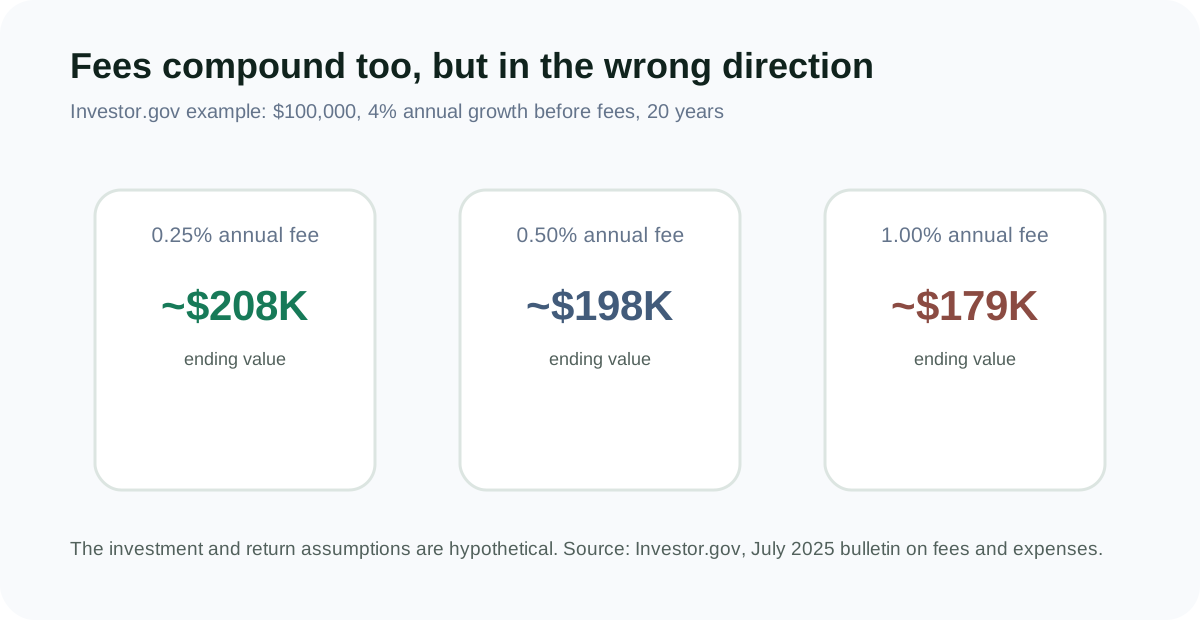
Small percentage differences can become large dollar differences because fees reduce both the portfolio balance and the future returns that balance could have earned.
This does not mean the cheapest investment is automatically the right investment.
It means costs deserve attention.
A higher fee should have a clear reason for being there, and investors should understand what they are paying for.
Debt can compound too
Compounding is not only an investor’s friend.
Interest on debt can also build on previous interest and unpaid balances.
The Consumer Financial Protection Bureau notes that credit card interest may be compounded daily, which can cause balances to grow faster when debt is carried from month to month.
That is why someone can invest consistently and still struggle to improve net worth if expensive revolving debt is growing at the same time.
The whole balance sheet matters.
In some cases, reducing very high-interest debt may improve a household’s financial position more reliably than increasing investment contributions.
Automate the contribution, not the optimism
You cannot automate market returns.
You can automate saving.
A recurring payroll deduction or bank transfer turns investing into a system instead of a monthly negotiation.
That is valuable because many financial decisions fail not because the plan was bad, but because the plan required repeated willpower.
Automation reduces the number of opportunities to skip a contribution.
When income rises, one practical approach is to increase the automatic contribution before lifestyle spending absorbs the entire raise.
Even a small increase can become meaningful if it remains in place for years.
A better mental model for compounding
Long-term wealth is influenced by several variables at the same time.
A useful simplified model is:
Contributions + Time + Investment Return - Friction
Friction can include:
- investment fees,
- taxes,
- unnecessary trading,
- high-interest debt,
- cash sitting idle for too long,
- and behavioral mistakes such as panic selling.
You cannot control future market returns.
You can influence how much you save, how consistently you invest, how diversified you are, how much you pay in fees, and how you respond when markets become uncomfortable.
Those controllable variables deserve more attention than trying to predict the next year’s return.
Starting late does not mean giving up
One of the least helpful messages in personal finance is that someone who did not start investing in their twenties has already failed.
That is not true.
Starting earlier is mathematically advantageous because more time is available.
But a person starting later can still make meaningful progress by increasing contributions, reducing unnecessary costs, using tax-advantaged accounts when appropriate, and setting realistic goals.
The point of understanding compounding is not to regret the years that have already passed.
It is to use the years that remain more deliberately.
The DollarAngle
Compounding rewards patience, but patience without meaningful contributions is not a strategy.
Start early if you can.
Start now if you did not.
Increase contributions as your financial capacity improves.
Keep unnecessary costs low.
Diversify.
Give the system time.
Compounding becomes powerful when it is attached to a repeatable financial process.
The process matters first.
The math has something to work with only after the money is actually saved and invested.
Sources & further reading
- Investor.gov: Compound Interest Calculator
- Investor.gov: How Fees and Expenses Affect Your Investment Portfolio
- Investor.gov: Mutual Fund and ETF Fees and Expenses
- Consumer Financial Protection Bureau: Know Before You Owe, Credit Cards
DollarAngle provides financial education and commentary for informational purposes only. Investment returns are not guaranteed, and investing involves risk, including possible loss of principal.